



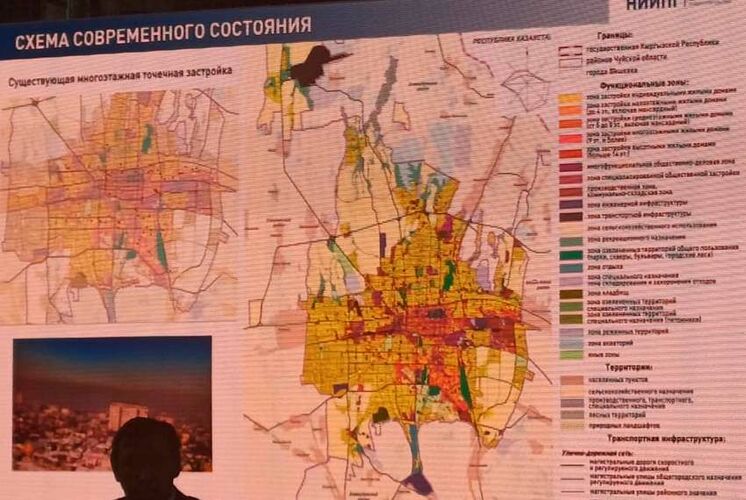
Two-day public hearings are being held in Bishkek on the draft of the city’s new master plan until 2050. The document, developed by specialists from the St. Petersburg Research Institute for Advanced Urban Development, has sparked broad public debate.
Today, discussions covered the Oktyabrsky and Sverdlovsky districts. Similar meetings were previously held with residents of Leninsky and Pervomaisky districts of the capital. More than 400 people are taking part in the discussions, including Vice Mayor Azamat Kadyrov and the management of Bishkekglavarkhitektura.
The developers presented critical figures on the city’s current condition. Bishkek covers an area of 41,000 hectares and has a population of 1,321 million. At the same time, the capital’s social infrastructure is significantly behind demand:
- Availability of kindergartens stands at only 30 percent, with about 300,000 children on waiting lists;
- Emergency medical services and hospitals are staffed at just 35 percent;
- Availability of sports halls is 58 percent, swimming pools — about 10 percent;
- Green space per resident amounts to 4 square meters, compared to the standard of 16 square meters.
Urban planning specialist Irina Grishechkina noted that the city is losing its cultural heritage: of 300 heritage sites, half have already been lost. Development of southern Bishkek is constrained by a tectonic fault, while a shortage of state-owned land hampers the construction of new social facilities.

Public discussions are ongoing, with authorities recording residents’ proposals to revise and refine the final document.